Curriculum Information
On this page
Curriculum Statement
Intent
Our curriculum places students at the heart of the Overton community. It is ambitious, inclusive and broad, ensuring that every student has access to a rich and fulfilling educational experience that develops the knowledge, skills, understanding and values they need to thrive in an ever-changing world.
At Key Stage 3, we are committed to providing a broad and balanced curriculum that exposes students to a wide range of subjects, disciplines, experiences and perspectives. We believe in the importance of breadth and exploration, allowing students to discover new interests, develop their talents and build secure foundations before making informed choices about their future pathways.
Our curriculum extends far beyond the formal subjects taught in classrooms. Through trips, visits, assemblies, enrichment opportunities, extracurricular activities, social experiences and wider school events, we seek to broaden students' horizons, develop cultural capital and strengthen their sense of belonging and responsibility to others.
Underpinning this is a commitment to the Overton values, which shape how our students learn, interact and contribute to the world around them. We place particular importance on developing confident communicators, thoughtful citizens and respectful individuals who appreciate diversity, value their community and understand their role in making a positive contribution to society.
Literacy is central to this ambition. We aim to develop students as fluent and confident readers, articulate speakers and effective writers, equipping them with the vocabulary, language and communication skills to access learning, express their ideas and participate fully in society.
Ultimately, our curriculum seeks to develop well-rounded, knowledgeable and compassionate young people who feel connected to their community, recognise their potential and are prepared to make a positive contribution to the wider world.
Implementation
At Overton Grange School, our curriculum is implemented through consistently high-quality, evidence-informed teaching that enables all students to acquire, retain and apply knowledge over time. We believe that a carefully designed curriculum can only achieve its intended impact when it is delivered effectively in every classroom, every day.
Our Teaching and Learning Principles provide a shared framework for excellent classroom practice across the school. Whilst recognising the distinct nature of individual subjects, these principles ensure that students experience a consistent approach to learning, enabling them to focus their cognitive effort on mastering curriculum content rather than navigating differing classroom expectations.
Lessons are characterised by clear routines, strong teacher explanations, expert modelling, purposeful questioning and regular opportunities for students to practise and apply their learning. Teachers systematically revisit prior knowledge through retrieval practice, helping students to strengthen long-term memory and make connections between current and previous learning. Frequent checks for understanding allow teachers to identify misconceptions, adapt instruction and provide timely support so that all students can make progress through the curriculum.
We maintain high expectations for every learner. Through adaptive teaching, carefully planned scaffolding and responsive classroom practice, teachers ensure that disadvantaged students, students with SEND and those with English as an Additional Language can successfully access the same ambitious curriculum as their peers. Equally, appropriate challenge enables the most able students to deepen their understanding and achieve highly.
Learning extends beyond the classroom through homework, reading, educational visits, enrichment opportunities and an extensive extracurricular programme. These experiences reinforce curriculum content, broaden cultural capital and help students understand the relevance of their learning within the wider world.
The implementation of our curriculum is continually strengthened through professional development, instructional coaching, collaborative planning and rigorous quality assurance. Through these processes, we ensure that curriculum intent is consistently translated into classroom practice and that students receive a rich, coherent and ambitious educational experience.
As a result, students develop secure knowledge, strong understanding and increasing independence as learners. They are well prepared for the next stage of their education and equipped with the knowledge, skills and character needed to thrive in adult life.
Impact
At Overton Grange School, we measure the success of our curriculum by the extent to which students know more, remember more and can do more over time. The impact of our curriculum is seen not only in examination outcomes, but also in students' developing knowledge, skills, character and readiness for the next stage of education, employment and adult life.
Students’ progress is carefully monitored through a structured programme of formative and summative assessment. Across Key Stage 3, students are assessed against subject-specific criteria that are linked to their individual starting points. Upon entry to Year 7, students are allocated an Inspire, Achieve or Endeavour pathway using Key Stage 2 outcomes or Cognitive Abilities Test (CAT) data where appropriate. Departments assess students against clearly defined subject rubrics, enabling teachers, students and parents to understand whether performance is above, at or below expected levels within each pathway. This approach provides an accurate picture of student achievement whilst maintaining high expectations for all learners.
Assessment information is used alongside day-to-day classroom evidence to identify strengths, address misconceptions and inform subsequent teaching. Through regular review points, curriculum leaders evaluate how effectively students are acquiring and retaining the knowledge and skills identified within curriculum plans. This ensures that curriculum delivery remains responsive whilst maintaining fidelity to subject intent.
At Key Stage 4 and Key Stage 5, students complete a rigorous programme of assessments, including mock examinations that replicate the demands of external qualifications. Following each mock examination cycle, departments engage in structured moderation activities to ensure assessment accuracy, consistency and shared understanding of standards. These moderation processes strengthen the reliability of assessment judgements, inform curriculum refinement and support targeted intervention where required.
The impact of our curriculum is reflected in strong student outcomes, high levels of participation in enrichment and wider school life, and the successful progression of students into further education, apprenticeships, employment and higher education. Equally important is the development of confident, articulate and responsible young people who are equipped to contribute positively to their communities and wider society.
We continually evaluate curriculum impact through assessment outcomes, moderation, quality assurance processes, student voice, attendance, behaviour and destination data. This evidence enables leaders and teachers to identify strengths, address emerging priorities and ensure that all students, regardless of background or starting point, achieve success.
Ultimately, the impact of an Overton Grange education is that students leave us with the knowledge, qualifications, skills and personal qualities needed to thrive in an ever-changing world. They are well prepared for their next steps and empowered to lead successful, fulfilling and socially responsible lives.
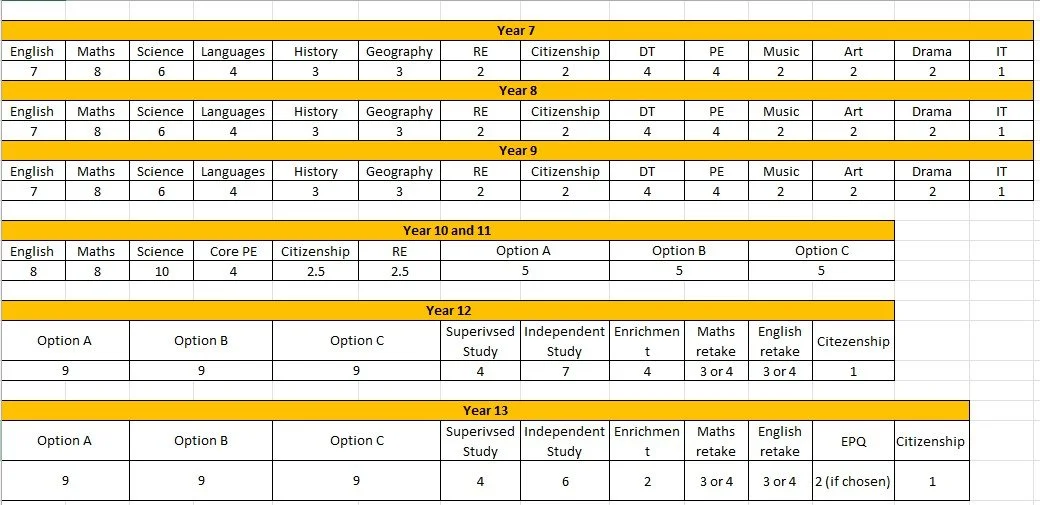
Curriculum Offer 2026 - 2027
Departments